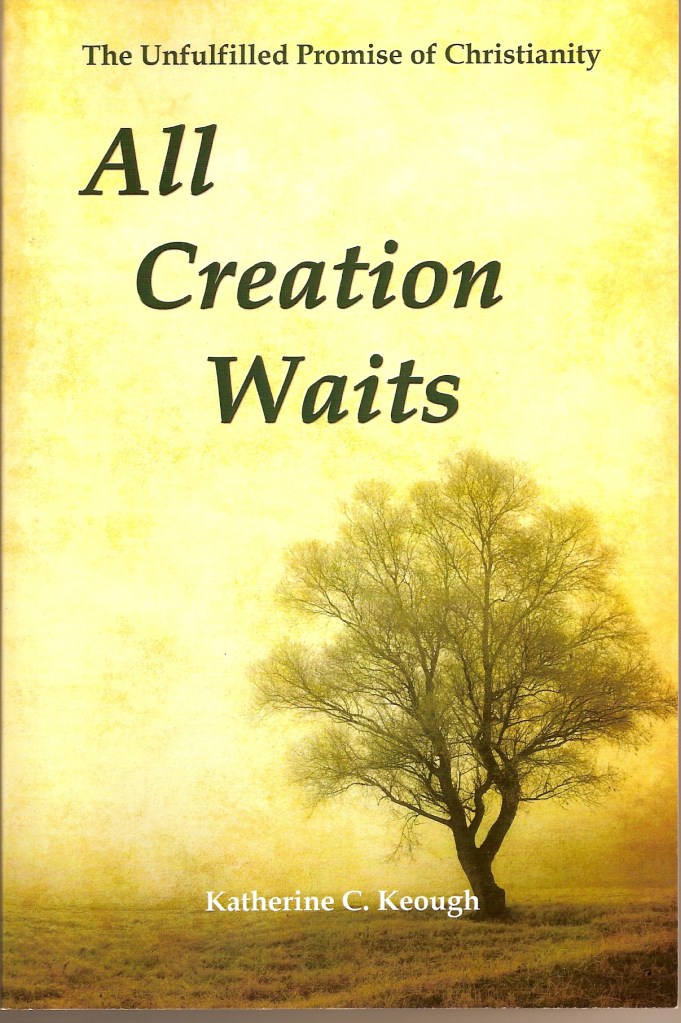
When I wrote my book, I included a subtitle, “The Unfulfilled Promise of Christianity.” This was important to me because it is frustrating to realize how long Christianity has been around and how creation is still waiting for Christians to figure it out. Instead of bringing the possibility of change to our world that the coming of Christ Jesus foretells, Christians just made another religion. This religion in many ways was no different than all the other religions of the world.
The biggest problem seems to be that our eyes got turned toward heaven and away from the earth. It seemed to me that Christianity was all about getting ourselves to heaven and avoiding hell. People even joked about baptism as “fire insurance.” Parents in Catholic churches rushed their babies to the baptismal font out of fear that their children would be exiled to a made-up place called Limbo, where they would be separated from them forever. As I wrote:
“Jesus did not found a Church, or even a new religion, but told us to “follow him” in a new way. He did not give us a set of dogmas and doctrines that must be believed in order to be saved. Giving mental assent to doctrines does little to change ourselves, or the condition of our world. Jesus was the first born of a new hope for Creation, a completely new way of being, not the first member of a new religious system; not the founder of a new Church. His way was a new way of living, not a new creed to memorize. Human beings are the ones who create religious systems, creeds and cults, not God. If we follow God’s way of living, shown to us in Jesus, filled with the Spirit of God, we will bring about the peaceful coexistence of Creation. You do not need to be a Christian to do things in God’s way.”
When we pray the prayer that Jesus is said to have taught us, we pray: “thy kingdom come on earth as it is in heaven.” In the last writings in our bibles, we hear of a new Jerusalem coming down to earth and that God will live among us. Now, think back to Genesis, when God walked and talked with people on the earth that God created. God intends to be with us right where we are, here on earth. God is present with us now. We, however, often forget God’s presence. Strangely, God loves us anyway. But God recognizes that we need to be saved — from ourselves — and that creation needs to be saved, too. We, who were meant to participate with the Creator in ensuring that this earth, our part of creation, is a planet of harmony, wholeness, and divine order have failed in our task. Earth is meant to be a place where compassion rules. Earth is where God has placed humanity and given us stewardship. We are the caretakers of this planet, and that means we are supposed to take care.
Humanity was created to be a blessing for the earth but has become a curse. For example, we are driving other creatures into extinction, and we are not that kind to one another either. The current extinction crisis is often referred to as the sixth mass extinction. See these bullet points from the WWF:
Just to illustrate the degree of biodiversity loss we’re facing, let’s take you through one scientific analysis…
- The rapid loss of species we are seeing today is estimated by experts to be between 1,000 and 10,000 times higher than the natural extinction rate.*
- These experts calculate that between 0.01 and 0.1% of all species will become extinct each year.
- If the low estimate of the number of species out there is true – i.e. that there are around 2 million different species on our planet** – then that means between 200 and 2,000 extinctions occur every year.
- But if the upper estimate of species numbers is true – that there are 100 million different species co-existing with us on our planet – then between 10,000 and 100,000 species are becoming extinct each year.
Unlike the mass extinction events of geological history, the current extinction challenge is one for which a single species – ours – appears to be almost wholly responsible.
There is an old saying: “You are too heavenly minded to be of any earthly use.” We Christians became too heavenly minded. We need to realize first of all that heaven is not a place! It is not up there somewhere. Heaven is simply wherever God is, and God is everywhere. The ancient philosopher, Plato, gave us this idea that humans were made up of two parts, a body and a soul. He believed these were distinct substances. He believed the soul is immortal and superior to the body. He believed in a realm of judgment where souls receive rewards or punishments. As Greek philosophy began to influence Christianity, we began to talk about the “poor souls in purgatory” and used other ways of demonstrating that we had been influenced by Greek philosophy. This in spite of the Apostles Creed stating that we believe in the resurrection of the body.
To be human is to be embodied and whatever our afterlife looks like, it is an embodied one. The resurrection stories in our scriptures provide a hint of what that might look like. However, salvation is not about the afterlife, though that is what we have focused on to the exclusion of this life. Salvation is about saving God’s plan for the earth today. Christians are meant to be practical, down-to-earth beings, not pie-in-the-sky-by-and-by beings. The salvation God provides through Christ Jesus is the corrective teachings that Jesus gives to us. These teachings can help save us and our world.
Jesus the Christ is the Word of God, the revelation of what God expects of humanity. God expects all humanity to act justly, to love mercy, and to walk humbly with their God. (Micah 6:8) Jesus is the fullness of what a human is meant to be, and he expects us to follow him. By follow him, he means to be like him, loving one another in the same way that God loves us. As I wrote:
“Every human being is created in the image of God and is a child of God (John 1: 9). Bringing about the kingdom of God on earth is not a matter of religion as much as a matter of persuasion. Every person has that of God within him or her that can be awakened. Christianity is meant to bring all things together through Christ. It is Christianity’s purpose to awaken that of God within each person. The purpose of Christianity is to acknowledge God’s presence in the world, to make known the values of God, and to bring about the kingdom of God. It is NOT so much about making more Christians, as it is about fulfilling the mission of the Body of Christ. The advantage to initiating more Christians is so we have more people who are “in the know,” and can take on the mission of God. What counts is accomplishing the mission of Christ, not filling up Churches with religious members. Christianity is not a numbers game. Who cares how many Church members there are if these members are doing nothing to advance the kingdom of God?”
And you will also read this in my book: “The early Christians took naturally to a communal life that involved a true sharing of wealth so no one had too little and no one had too much. There was a compassionate caring for one another. The early Gospel was “Good News” for the poor in fact, and not just in theory. This was not a “pie-in-the-sky” theology. Because of the immediate and real communal caring for one another the admonition of Jesus to not worry about food, clothing and shelter was easy to fulfill, because God, present in the community, took care of the needs of the poor. This mission to care for the little ones was not without its struggles. Favoritism raised its ugly head within the first generation, as did the reluctance to share. It was difficult for people to change their ways. But the ways of humanity are not the ways of God, and that is the whole point of the incarnation – to show us God’s way.”
The first followers of The Way understood the message of Christ. It was said that they loved one another. They understood that they were embracing a whole new way of life. We need to get back to understanding that it is the way of life, the way of love and compassion, that will save humanity and creation, and this is the salvation we need.
Don’t worry about your afterlife. God has a plan for that already in mind. Our worry is in the here and now — how are we participating with Creator to bring harmony, wholeness, and divine order to our part of creation? Please know, that divine order is not some kind of dominance thing, with humans on top and everything else below, and some humans more on top than others. It is an equality thing. Every human being is created in the image and likeness of God and therefore deserves dignity and respect. When anyone is treated unkindly, cruelly, brutally, and with disrespect, then divine order is broken. When the earth is treated as nothing more than a resource for human greed, then divine order is broken.
In the end, the waiting of creation is not a passive ache but a living testimony to God’s unfinished promise—a reminder that even in the world’s fractures, a deeper wholeness is already stirring. Our task is to stand within that tension with courage and trust, bearing witness to the hope that has taken root and will, in God’s time, be fulfilled.
Bishop Kedda

