Suddenly there came a noise
a driving wind heard throughout the house
Fire was cast upon the earth
and started burning in our hearts
The Spirit of God poured out upon the earth
on sons and daughters, old and young,
It is the great and glorious day of our God.
The Ecumenical Catholic Communion (ECC), like the Old Catholic Church in Utrecht and elsewhere, looks to the early Church for guidance. If you think about it, we all started off first as Christians (Acts 11:26), and then as Catholics (writings of St. Ignatius of Antioch around 107 A.D). Both names for us followers of Jesus were attached to the followers of Jesus in Antioch. See FAQ: How Can You Be Catholic if You Are Not Under Rome? – Ecumenical Catholic Diocese of the Pacific Northwest for more about being Catholics.
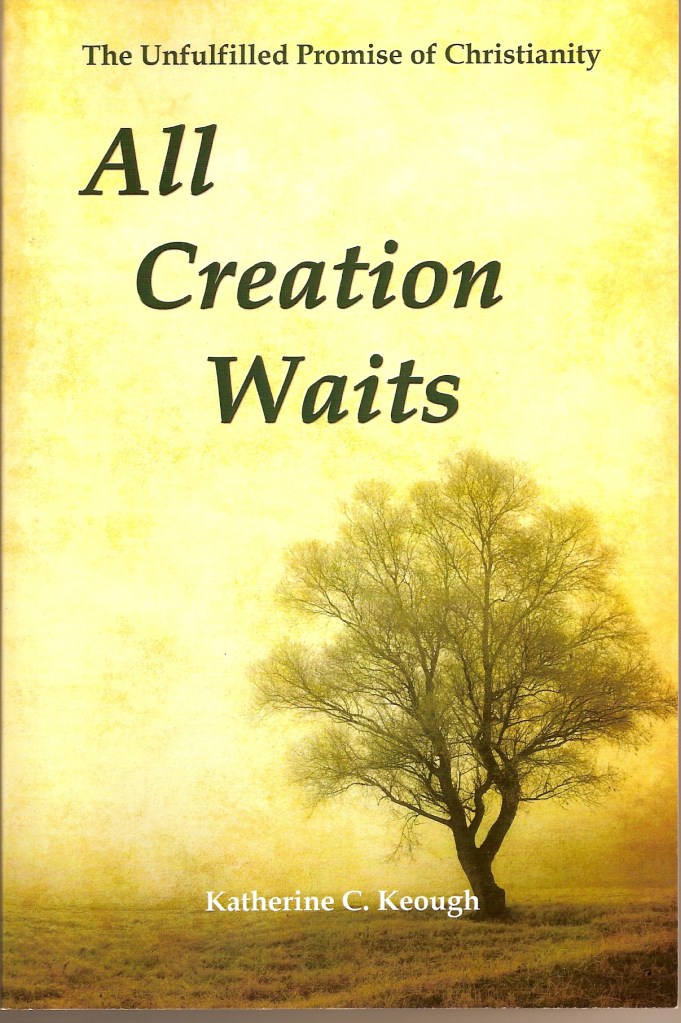
I am now turning to chapter three of my book, All Creation Waits. It was in this chapter that I looked back to how the church began and wondered, how did the Catholicism that I knew get so far off track. I grew up as a Roman Catholic and it was later in life that I discovered the ECC and gladly moved over into what I recognize as a good attempt to be what Catholicism was meant to be. The ECC is rooted in the Old Catholic Church. Here is what I wrote:
“The early Christian community began in a very different way from what it would become. The early followers of Jesus had no plan to separate from their Jewish roots, or to form a religion, and certainly had no intention to form a church. They continued in their Jewish traditions, going to the temple courtyard to pray, listening to the Hebrew Scriptures in their synagogues, still following the Jewish laws and traditions. But they also met in homes to remember Jesus, to remember what he taught them, and to remember him in the “breaking of the bread.” They became followers of “The Way,” and this changed them, and changed the way they lived. They were remarkable in this particular way – they loved one another. They were remarkable and odd to the world around them because of their choices for life, for peace, for reconciliation.
It is said that the birthday of the Church is on Pentecost with the outpouring of the Spirit of God. The Spirit of God that has come into our world brings a new wine, and this new wine must be put into new wine skins. The earliest Christians tried to stay within the familiar structure of Judaism, within old wine skins. They saw the Jesus movement as a reformation and renewal movement for Judaism. But the Spirit of God had been poured upon them, and this “new wine” soon threatened to burst and tear the “old wine skins.” The early Christians were literally chased out of the synagogues because of the threat they posed to the old way of doing things. An old structure can either change to accommodate “new wine” or must spew it out. The evidence of history shows us that periodically, and from the beginning, the Spirit of God comes into our world as a new wine, usually with the same outcome. Old structures change to accommodate the new wine, or spew it out. God’s Spirit has been with us since the dawn of Creation, and Creation must react.
Jesus did not found a Church, or even a new religion, but told us to “follow him” in a new way. He did not give us a set of dogmas and doctrines that must be believed in order to be saved. Giving mental assent to doctrines does little to change ourselves, or the condition of our world. Jesus was the first born of a new hope for Creation, a completely new way of being, not the first member of a new religious system; not the founder of a new Church. His way was a new way of living, not a new creed to memorize. Human beings are the ones who create religious systems, creeds and cults, not God. If we follow God’s way of living, shown to us in Jesus, filled with the Spirit of God, we will bring about the peaceful coexistence of Creation. You do not need to be a Christian to do things in God’s way. Becoming a Christian is not what is essential; becoming a Christian is not an end in itself. What matters is whether or not a person follows the ways of God shown to us by Christ, living in our midst. When people begin to live in the ways God prescribes, then the kingdom of God comes on earth. God prefers us to follow the ways of the kingdom in mercy, forgiveness and peace, then any of our religious practices. Religious practices can actually get in the way, or take us away from the kingdom of God. The rigorous practice of religion does not make up for neglect of the kingdom of God. As it is written: Seek first the kingdom of God! (This does NOT mean seek first to get yourself to heaven).”
The Church is meant to be a vehicle for transmitting the revelation of Christ Jesus down through history. We need a container for all that God has revealed to us down through the ages. Included in what has been passed down through the generations are the rituals and traditions that bring Christianity to life. We are earthy people and we need rituals to help us connect with God, because we learn about God through our human senses, not just through words. For us Catholics this generally means sacraments and sacramentals. All of the rituals and liturgies enable us to enter into a relationship with God, who is Love.
Our diocesan vision statement speaks of “restoring relationships of justice, peace, and love with God, with one another, and with all of creation by living out our baptismal ministry as the Body of Christ.” Our mission statement reminds us that “participation of all the baptized in the work of the Church is essential to our call as the Body of Christ serving in our region.” Together, they remind us who we are and where we are going: toward the restoration of all creation with God, through the shared ministry of all the baptized.
God is not isolation, but relationship, and the foundation for all our relationships. When Christ is at the center, we love better. Our love becomes less selfish and possessive, more patient, forgiving, and faithful. Jesus calls us to a radical reordering of our priorities: God first, and everything else finds its proper place. Faith is not a hobby or an add-on to life. Faith is a whole way of life. This is what we need to remember. We are called into a way of life, not a mere religion. This is why it is not essential to be a member of any particular religious organization to be living the way God means for humanity to live.
However, it is by being part of a faith community, the thing we call “Church,” that we learn the way of life that leads to true justice, peace, and love for all of creation. The world would have us live in a very different way from what God has in mind for us. If we don’t have a faith community to show us the way of God, revealed through Christ, we will most likely follow the way of the world. Micah 6:8 is meant for all of humanity: “God has shown you, O mortal, what is good. And what does the Most High require of you?
To act justly and to love mercy and to walk humbly with your God.” Jesus shows us what this means in real life.
This way of life is practical and every day. The hospitality, kindness, mercy, compassion, and burdens we help carry are not just nice things we do. They are how we participate in the ongoing mission of Christ Jesus. We let the love of God, shared with us, spill over into our everyday lives. I go to our faith community every week in order to get plugged into that love, refreshed and renewed, so I am able to go out the Church doors and live as God means for us to live. All creation waits for humanity to live as God means for us to live.
May we become everyday disciples, rooted in God’s love and sent to share it, so that all who meet us may come to know the God of love who sends us.
Bishop Kedda

